Kombucha recipes
https://www.hofladen-bauernladen.info/in/leinfelden-echterdingen/418
https://www.reddit.com/r/Kombucha/
https://www.reddit.com/r/Kombucha/comments/jlkqpf/anyone_using_inulin/
Here's what a half gallon batch with 1/4 cup sugar and 1/4 cup Chicory Inulin with 12g Himalayan white tea looks after 5 days. The prior pelicle was a sinker, but the new one is nearly 1/4" thick already!
https://ec.europa.eu/food/safety/labelling_nutrition/claims/register/public/?event=search
live microorganisms which when administered in adequate amounts confer a health benefit to the host.
https://www.fairment.de/wissen/kombucha-wissen/kombucha-alkohol/
Kombucha Troubleshooting
Sollte die Starterflüssigkeit besonders trüb sein, ist das ein Indiz für eine Übervölkerung von Hefen. In einem solchen Fall hilft folgender Trick: Stelle den Starter im Kühlschrank kalt. Nach einiger Zeit bildet sich ein sichtbarer Bodensatz. Filstere den Starter dann durch einen feinen Filter (zum Beispiel einen Kaffeefilter) und lasse den Bodensatz zurück.
Dein SCOBY sollte vor jedem neuen Ansatz einmal lauwarm abgewaschen werden. Achte dabei darauf, die dunklen Hefereste vom Teepilz zu entfernen.
What are fermented foods and which are best for improving our gut health?
Traditionally many different cultures have used the process of fermentation to preserve foods.
In India lassi was a common pre-dinner drink, Asian cultures enjoy pickled fermentations of cabbage, turnips and eggplant, kefir originated in the northern Caucasus Mountains and sauerkraut is associated strongly with Germany. Other fermented foods include yoghurts, cheeses, sour dough bread and chutneys.
However, as well as lasting longer, fermented foods often contain a variety of ‘good’ bacteria which, if they can survive the journey to our gut, can be beneficial for our health.
In our big probiotics study, the group taking a fermented milk based drink called kefir saw significant changes in their gut bacteria – specifically a rise in a family of bacteria called Lactobacillales, which are known to maintain gut health.
We wanted to explore this further and find out which other fermented foods might be good options for improving our gut bacteria, so we gathered some of the most popular products and put them to the test.
We took 5 foods: a soft cheese, sauerkraut (preserved white cabbage), kimchi (traditional Korean fermented vegetables), kefir and kombucha (a fermented tea-based drink).
We gathered together homemade versions of these foods, made by volunteers from The Fermentarium, and we also bought readily available ‘off the shelf’ versions from supermarkets and shops. Once we had all of our samples, we sent them to the lab for testing.
Martha Villegas-Montes and a team at Roehampton University analysed our samples, looking for specific bacteria that we know to be good for our guts and Dr Paul Cotter from Teagasc Food Research Centre in Cork presented the results.
When we looked at the shop bought sauerkraut, kimchi and soft cheese we didn’t find any of the bacteria we were looking for. This is probably because these foods will have been pasteurised to make them safe and to improve their shelf life - both important factors in commercial food production. The downside however, is that these processes also kill off the ‘good’ bacteria that might be present.
Two of our shop-bought foods, the kefir and the kombucha, did contain levels of the bacteria. This suggests that both of these foods were made using traditional processes and were not pasteurised, meaning that the good bacteria survived.
In our homemade foods, which had all been produced using traditional methods, we found diverse strains of bacteria and higher levels, particularly of a type called Lactobacillus.
There are many different species and strains of Lactobacillus – some that have good health-giving properties that we know about, and some that don’t. But by eating a fermented food with lots of different varieties, like our homemade versions, there is a chance that some of the strains present will be good for you.
There’s still a lot of research that needs to be done into the world of our gut bacteria, but so far studies suggest that for general good gut health, a range of bacteria is best, so it would seem that traditionally made fermented foods - whether they be homemade versions or commercial varieties that are unpasteurised - are a good way to achieve this.
But there are important things to be aware of if you’re planning to produce your own homemade fermented foods. Just as homemade versions can contain greater numbers and varieties of beneficial bacteria, they can also contain harmful bacteria, particularly if they are not produced or stored correctly. So if you do want to make your own you should follow a recipe, use the correct equipment and store your foods at the correct temperature.
https://de.b-ok.cc/book/976543/8cb8c2
https://de.b-ok.cc/book/2665736/6adabf------
https://de.b-ok.cc/book/2289559/7f0ceb
https://de.b-ok.cc/book/2872043/29a4bc
https://de.b-ok.cc/book/2644955/60539c
https://de.b-ok.cc/book/2456392/ad8ee3
The Prepper’s Canning & Preserving Bible (5 in 1) | Tyler Gordon | download (b-ok.cc)
Kombucha shop
phases
first, only pre-defined flavors sold in a small shop; production facilities should not be visible to avoid quick arisal of competitors
then, choice of ingredients; possible to define concentrations
introduction of sensors
introduction of lab equipment for automatic testing of sugar and alcohol level, as well as pH
introduction of GUI for interactive tracking of state of fermentation; do not provide observables to customer but another scale, such as sour/medium/sweet, in order to avoid fast followers
finally, own ingredients can be provided
concept can be extended to other fermented beverages: spirits, kefir, etc.
best locations might be close to universities
own organic produces can be converted to more noble products with higher margin
energy consumption should be covered mostly by PV; rented place should allow mounting of PV; alternatively, production facility in the beginning in a village; might be only important for first fermentation
need to consider required permits for selling beverages containing alcohol
in the beginning, no large profits to be expected; important to expand as quickly as possible to avoid settling of competitors
crucial to be price competitive to supermarket products
it might be wise to consider keeping regular jobs as a safety net; need to hire employees, e.g. aunties
consider offering merchandise produced by family
consuder student discounts
consider subscription model
long-term target is to increase profit by optimizing supply chain
consider supplier agreements with restaurants
consider local delivery; long journeys not recommended without expensive measures
need to ask for subsidies; better to keep quite on Kombucha activities ans tell people that it’s going to be a fruit bar with locall produced fruits
need to create charts to show predicted number of locations, emploees, etc.
need to define criteria to pass from one phase into the next, such as revenue/etc.
It is forbidden to use vessels/containers from outside to avoid contamination
Kombucha hotel must be in another location as a backup
need to clarify liability in case of consumption b an allergic person
hygiene is crucial
need method to identif leaking glasses: vacuum chamber to measure leakage rate
consider offering bubble tea with fruit pearls made from own produces
need to test qualit of different bottles; ideall, onl bottles for multiple use will be provided
the price should be affordable; need to compare to similar trendy drinks; price should be comparable to Cola
https://www.karekod.org/blog/icecek-fiyatlari-2022/, 2022-11-15
Coca Cola, yedigün, pepsi, lipton, fusetea: 15 YTL
Ayran:17 YTL
uludag: 10 YTL
https://fastfoodfiyatlari.com/pinar-su-fiyatlari/
erikli su, 19 l:
https://haberglobal.com.tr/ekonomi/damacana-su-fiyatlari-2022-ne-kadar-19-lt-su-fiyati-159552
19 l: 25 YTL
offer a fast option that uses higher temperature for 2F
need to consider redundancy for heating elements to avoid spoiled batches and minimize safety risks
set up a camera system to obtain time lapse videos to track growth of scoby and circulation of liquid
continuous scouting required to come up with new flavors; check reddit and commercial producers of kombucha
subscription based model with free choice of flavors
need to have a concrete plan to scale up production quickly by factor of two if current capacity is exceeded
in the beginning it might be required to obtain publicity by opening store in area frequented by a lot of students
need to decide whether each bottle should have unique ID or QR codes tags can be transferred between bottles; advantage could be that history of bottles is logged; however, need to consider that QR code might be illegible
water filters; ideally visible by customers
Philips X-Guard AWP3703 & AWP3704 with AWP305: 10 € per 1000 l
BRITA P1000: 50 € per 500 l
Quality control to be set up
offer seasonal drinks
consider big data analysis to identify most popular drinks
seasonal fluctuations?
Small intented variations: correlate with customer feedback or sales number
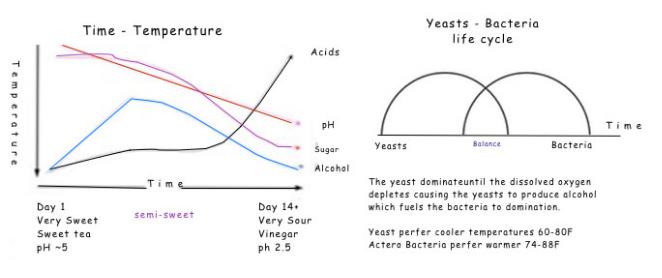
consider performing systematic DoE with logging of temperature, pH, alcohol and sugar content
provide option for filtered or unfiltered boocha; meant to remove the strains of yeast; filtering should be charged due to usage of a second bottle; Weck bottle should be used before filtering due to ease of cleaning
cleaning procedure must be meticulously documented
use of safety glasses is compulsory; burping/venting of bubbles should be food practice before passing bottles to customer
need safety SOPs; especially for broken glass, cleaning, etc.
need air filtration system to avoid complains by customers and neighbors
cleaning of bottles solely with hot water, steel beads and white vinegar
estimation of number of customers for on-site sale; online sale not considered
https://www.linkedin.com/pulse/retail-story-how-passerby-becomes-customer-benjamin-zenou
5% of passers-by enter store
25% of visitors actually buy something
assuming 0,5 l sold per person
→ 100 customers, 400 visitors, 8000 passers-by
estimation of electricity cost
15 W heating mat per 10 l in a well-insulated thermobox, 500 l heated at each time → 750 W
PC, server run 24/7: 500 W
fridge and freezer: 20-50 W per unit, 100 l per unit → maximum 5 units → 500 W
→ energy consumption per year: 15330 kWh
assuming 30 ct/kWh → 4599 € per year → 383 € per month
==> it might make more sense to carry out first fermentation at a location with low energy cost and availability of photovoltaic systems
strategy could be to invest in modular PV first on existing building; only after customer threshold exceeded, battery should be considered; also possible to turn off heater at night
cost estimation; premise: 50 l sold per day, 1500 l per month
minimum profit margin: 10%
expected sales price: 1 €
full-time labour: 250 €
tea, filtered water (0,1 € per l), sugar: 250 €
juices (0,5 € per l, 10%): 75 €
rent: 200 €
electricity: 400 €
marketing: 50 €
electronics: 50 €
miscellaneous: 50 €
initial investment: 5000 €
heating elements
vessels, bottles, jars
thermoboxes
shelves
computer
water filter
decoration, lamps, signs
dish washer; no soap allowed!!!
in long-term, vegetarian food can be put on the menu: falafel, etc.
https://www.ikegger.com/products/20l-keg-fermenter-in-one-fermenter-king-junior
Bormioli Rocco
Bormioli Flasche Swing 0,50 ltr.
https://www.metro.de/marktplatz/product/8713a587-cbaa-4a32-97af-c5f06a2dfa1f
https://www.metro.de/marktplatz/product/9d37e0ff-4101-4817-ae30-d544a7396ac8
WAS Germany – Bügelverschlussflasche
https://www.metro.de/marktplatz/product/a2e144fb-26ad-4d26-9dba-cad8994e24a8
BigDean 12x Glasflaschen mit Bügelverschluss 500ml
Bügelflasche 500 ml Typ B
https://www.glaeserundflaschen.de/buegelflasche-500-ml-typ-b
Gärkappe Größe 5
https://www.glaeserundflaschen.de/gaerkappe-groesse-5
Gärröhrchen aus Glas, Ø 10 mm
https://www.glaeserundflaschen.de/gaerroehrchen-aus-glas-oe-10-mm
Plaato - Digitaler Gärspund + WiFi
Getränkefiltration
https://de.wikipedia.org/wiki/Getr%C3%A4nkefiltration
https://de.wikipedia.org/wiki/Schichtenfiltration
https://brouwland.com/de/1076-schichtenfilter?q=Segment-Bier
https://brewbuch.com/how-to-make-kombucha/
https://www.kombucha.com/free-kombucha-brew-log/

